Fall is the best time to plant or prune a tree in the Columbia Basin, and the easiest time to accidentally break a city ordinance or get a call from your utility. With irrigation deliveries already shut off and freeze prep underway across the region, trees are the one part of the yard that still needs attention before winter — just not more water.
Unlike lawns, trees don't go dormant on a fixed calendar, and unlike sprinklers, pruning a tree near the street or a power line can require a permit you didn't know existed. Here's what applies where you live, and when to put the hose away for good.
When to stop watering your trees
WSU Extension Master Gardener guidance says trees should get their last deep watering of the season in early autumn, then be left alone. Lawns and shrubs get by on less water through fall, but a large, actively growing tree in your yard sharing that same irrigation zone is rarely getting enough — which is why WSU recommends a dedicated deep soak before you cut trees off for the year, according to a WSU Extension fact sheet on fall tree care.
Stopping on schedule matters more than it sounds. WSU horticulturist Linda Chalker-Scott's paper, "The Myth of Winter Watering," explains that temperate trees need to stop active growth in order to develop cold hardiness and survive freezing temperatures. Water encourages new growth. New growth right before a hard freeze is exactly what you don't want, because tender tissue is the most likely to be damaged when temperatures drop. The practical takeaway for Tri-Cities yards: give trees one good deep watering now, in mid-October, then let them head into dormancy on their own.
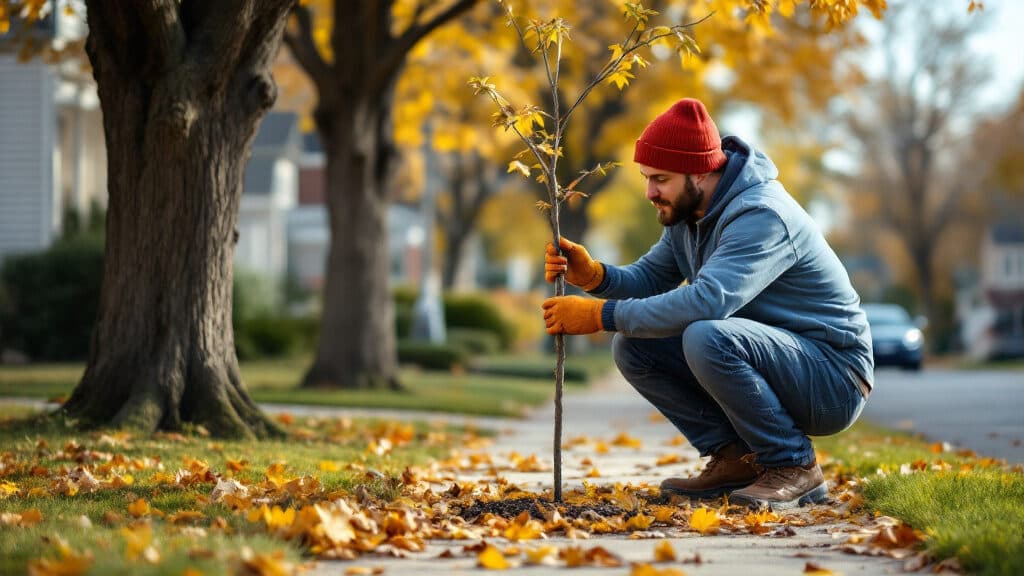
This is also why fall, not spring, is the better planting window here. A tree put in the ground now has weeks of mild soil temperatures to grow roots before next summer's heat arrives, without having to support leaf growth at the same time.
Permits: it depends which city you're in
Tree rules in the Tri-Cities are set city by city, and they mostly target trees in the public right-of-way: the strip between the sidewalk and the street, or the parking strip in older neighborhoods, not trees in your backyard.
Richland has the most detailed ordinance of the cities with published code. Under Chapter 22.14 of the Richland Municipal Code, a permit is required for "maintenance" of street trees, which the city defines specifically: pruning limbs larger than one inch in diameter on what the code calls Class I trees, or larger than two inches on Class II and larger trees. Routine care — watering, light trimming below those thresholds — doesn't need a permit. A municipal arborist, appointed by the parks and recreation director, runs the program and is the person to call before any bigger cut on a street tree.
Pasco regulates trees and shrubs through Chapter 12.12 of its municipal code. The city requires permission before planting, substantially pruning or removing a street tree or shrub. The code lays out the process in pieces: Section 12.12.050 covers permission to plant or prune, 12.12.080 covers permission to remove or substantially prune, 12.12.090 covers how permits get issued, and 12.12.100 spells out the removal procedure itself. If you're planning to take down or heavily cut back a tree between the sidewalk and the curb anywhere in Pasco, start with these sections before you call a tree service.
Kennewick and West Richland likely have comparable right-of-way tree rules, but a specific, citable ordinance for either city wasn't confirmed in researching this guide — West Richland's public code pages cover general code enforcement rather than a standalone tree ordinance. If you live in either city and are planning work on a street tree, call your city's public works department directly before starting; it's a faster answer than guessing.
Power lines are a separate issue from city permits
City tree permits are about the right-of-way. Line clearance is a separate responsibility that falls on the property owner, at least for the smaller lines that run to your house.
Benton PUD's tree and vegetation management program states that customers are responsible for pruning or removing trees that grow into the secondary power lines running directly to their home or business, and for keeping clear access to underground electrical equipment such as transformer boxes, according to Benton PUD's tree program page. That's different from the higher-voltage distribution lines running down the street, which the utility handles itself — and doesn't want homeowners or outside tree services cutting near.
That distinction also shapes Benton PUD's planting advice: choose a tree species and spot based on what's overhead and nearby, including power lines, before you put anything in the ground this fall, the utility has advised, according to a report by KEPR. A tree that looks fine as a six-foot sapling next to a power pole can become a maintenance problem, or a hazard, within a decade. Before digging this fall, check where your overhead secondary line runs and pick a planting spot, and eventual mature height, that won't put branches into it.
Franklin PUD, which serves Pasco-area and rural Franklin County customers, may have a similar line-clearance policy, but a published version comparable to Benton PUD's wasn't located for this guide. Franklin PUD customers with questions about trees near their service line should call the utility directly.
Fall tree checklist
- Give trees in your yard one deep, thorough watering now, separate from lawn irrigation, then stop for the season.
- If planting this fall, pick the spot based on the tree's mature height and spread, not how it looks today, especially near overhead lines.
- Before pruning or removing any tree between the sidewalk and the street, check your city's rules: Richland requires a permit for limbs over one or two inches in diameter depending on tree class; Pasco requires permission to plant, substantially prune or remove street trees and shrubs.
- Kennewick and West Richland residents should call their public works department to confirm local right-of-way tree rules.
- Prune or clear brush only on the secondary line running to your own house; leave anything near higher-voltage lines to the utility.