Kennewick has landed a $480,000 federal grant to study how to fix 12 at-grade railroad crossings that snarl traffic through downtown and the city center, the Tri-City Herald reported, in a story carried by Yahoo News.
Sen. Maria Cantwell's office announced the award as part of more than $104 million in federal infrastructure money going to projects across Washington state. The money comes from the Railroad Crossing Elimination grant program, created under the 2021 Bipartisan Infrastructure Law, which Cantwell authored specifically to address delays and safety problems at crossings nationwide, according to the Senate Commerce Committee.
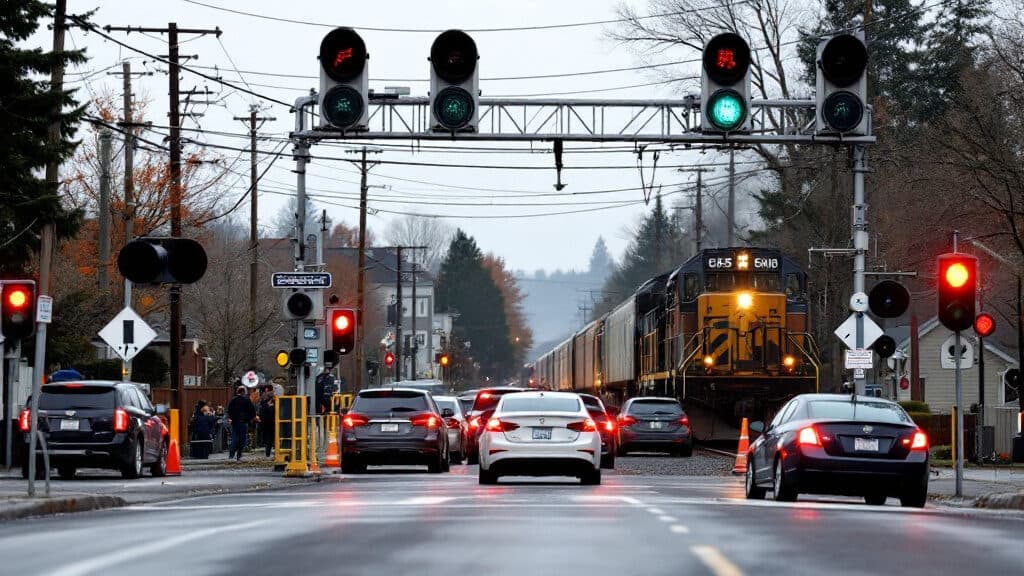
Anyone who drives through downtown Kennewick knows the problem. Combined, the city's at-grade crossings close as often as 50 times a day, and drivers can wait up to 20 minutes for mile-long trains moving as slowly as 1 to 35 mph to clear, the Herald reported. The busiest crossings sit at Edison, Fruitland, Benton and Kellogg streets.
"The city has been requesting financial support to study potential solutions to improve safety and alleviate traffic delays, including grade-separation and other enhancements, as rail traffic increases in the region," Kennewick Public Works Director John Cowling said, according to the Herald. Cowling added the city is "grateful to Cantwell and U.S. Rep. Dan Newhouse for championing safety in Kennewick" by including the study in the federal program.
Cantwell said the study would identify where "grade separations and crossing reductions would make the Tri-Cities safer and better connected," per the Herald's report.
A multi-year ask finally lands funding
This is not Kennewick's first attempt to get this work paid for. City officials asked state lawmakers in January for roughly $300,000 to study grade separations at downtown and central rail crossings, bundled with a request for about $14.7 million to widen Columbia Central Boulevard, according to citizenportal.ai's writeup of the city's legislative priorities. That state money doesn't appear to have come through, which likely pushed the city toward the federal grant program instead.
The Kellogg Street crossing in particular has been a known trouble spot for years. It showed up in a 2018 statewide study by the Freight Mobility Strategic Investment Board that catalogued road-rail conflicts and recommended a corridor-based approach to prioritizing fixes, according to the board's Phase 2 report.
A competitive program, and a bigger prize down the road
Kennewick's $480,000 is a small slice of a tightly contested national pot. The Federal Railroad Administration awarded $1.24 billion this round for 91 grade-crossing projects in 37 states, drawn from 264 applications nationwide seeking $4.9 billion, according to Trains.com. That roughly 1-in-3 success rate shows how hard it is to win funding even for planning work.
The program can also fund actual construction once a city has a vetted plan in hand. Washington has already won much bigger awards elsewhere — Washougal received roughly $40.5 million for a 32nd Street underpass, per the Senate Commerce Committee. If Kennewick's study identifies workable grade separations, the city could follow up with its own construction-phase application.
Kennewick's award follows a similar, separate grant Pasco secured to fix four dangerous crossings in that city, a sign the Railroad Crossing Elimination program is becoming a steady funding source across the region rather than a one-time windfall.
Still unresolved: the full list of all 12 crossings beyond the four busiest, a timeline for when the study will start and finish, which engineering firm will do the work, and whether BNSF, the railroad that runs the tracks through town, will formally participate. The Herald's report didn't specify a city council vote accepting the grant, so residents watching for next steps should check upcoming council agendas for that action item.