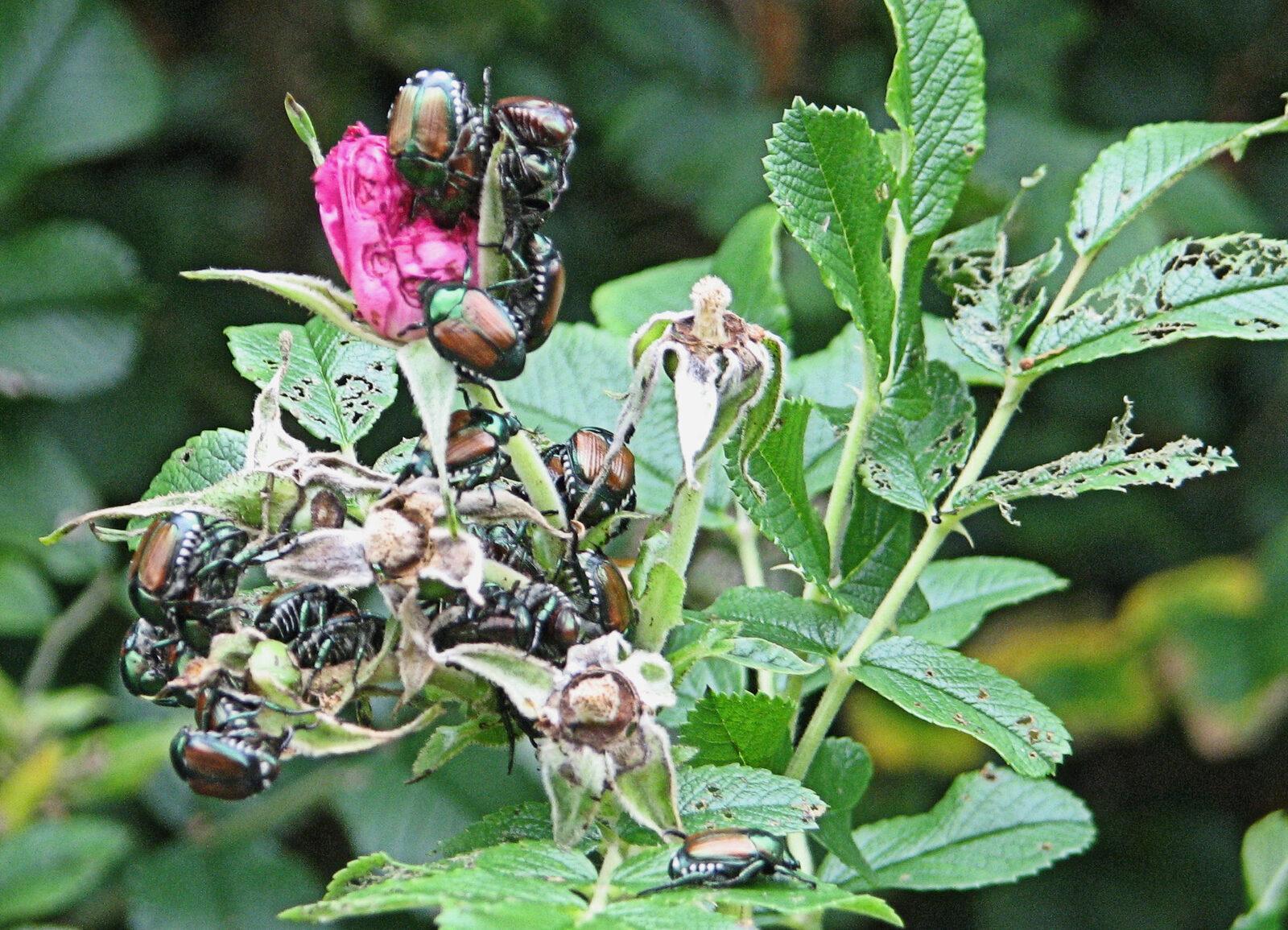
Washington agriculture regulators have widened an emergency quarantine meant to stop the Japanese beetle, a metallic green and copper pest that kills lawns and feeds on hundreds of garden and farm crops, as the insect keeps turning up in new parts of the Tri-Cities.
The Washington State Department of Agriculture adopted an emergency rule on April 28, 2026, amending Chapter 16-470 of the Washington Administrative Code to expand the internal quarantine boundary covering parts of southeastern Yakima County and southwestern Benton County, according to the agency's rulemaking record. Inside that zone, residents and growers are barred from moving plants, soil, plant waste and related material out, under WSDA's quarantine rules.
The expansion follows a multi-year creep of the beetle west across the Columbia River. It was first detected in the Tri-Cities area in Grandview in 2020, reached Richland in 2022 — likely a stray near a Target store — showed up in Pasco in 2023, and was confirmed in Kennewick for the first time in 2024, according to prior Tri-City Herald reporting carried by Yahoo News and the Yakima Herald.
Trap counts climbing fast
The scale of the problem became clear in 2025. Trappers recovered more than 2,000 beetles in Pasco that year — a five-fold jump from 2024 — while Kennewick logged its first detections, 10 beetles across nine trap sites, the Spokesman-Review reported, citing Tri-City Herald coverage. Statewide, WSDA caught nearly 70,000 beetles in Yakima County, about 2,400 in the Pasco area, 865 in King County and 10 in Kennewick, according to NBC Right Now.
Camilo Acosta, WSDA's Japanese beetle eradication project coordinator, told the Franklin County Commission last year the numbers showed the problem accelerating. "This is obviously a huge issue, and we're seeing this infestation unfold in real time," he said, according to the Herald's reporting carried by AOL. Earlier, after an isolated Pasco find, Acosta cautioned that a lone beetle wasn't necessarily a crisis. "A single beetle is less cause for concern because one beetle can't reproduce. But we need to be sure there are not more," he told the Tri-City Herald.
Karla Salp, a WSDA communications consultant, told NBC Right Now the Tri-Cities numbers, while rising, still leave room for the state to act. "A few thousand may not sound like that many, but it means we're still at a level here in the Tri-Cities where we can potentially eradicate them," Salp said.
What the quarantine means for residents
For growers and homeowners inside the quarantine zone, the rule means plants, soil, mulch, compost and similar material can't be moved out of the area — a restriction that adds cost and paperwork for farmers shipping hops, wine grapes, produce and nursery stock, per WSDA's quarantine guidance.
The state has also leaned on treatment. In 2025, WSDA conducted its first grub treatment in Kennewick, spraying nearly a mile of Columbia Park west of the Blue Bridge along the river, plus private land south of Highway 240, after beetles first appeared on that side of the river, the Herald reported via Yahoo News. For 2026, the state offered free lawn treatments in Benton, Franklin, King and Yakima counties, with a sign-up deadline of Aug. 16, 2026, according to WSDA's 2026 treatment page. The agency has also said it's preparing to expand eradication work into parts of King County as the beetle turns up beyond the Mid-Columbia, per WSDA's outreach materials.
WSDA sets hundreds of traps across the Tri-Cities each year to monitor adult beetles during their flight season, which runs roughly through September, according to the agency. Adults feed on more than 300 plant species, including roses, grapes, hops, sweet corn and raspberries, and the larvae chew through grass roots, killing lawns from the ground up.
Residents who spot a beetle are asked to report the sighting to WSDA rather than wait for a trap to catch it, according to the same agency release. Property owners inside Benton, Franklin, King or Yakima counties who want next year's free lawn treatment should watch for WSDA's spring sign-up window, which closed Aug. 16 this year but typically reopens as the agency plans its next treatment season.